Testing of probiotics in the fight against drought

Key facts:
- Researchers from Mendel University in Brno are testing probiotics (lactobacilli) on BOHEMIA SEKT vineyards in South Moravia, Czech Republic, as a natural way to help grapevines cope with drought and heat stress.
- Applied two to three times per season, the beneficial bacteria strengthen the vine's root system, improve nutrient uptake and support the immune system without leaving any residue.
- In semi-operational trials on Welschriesling vines in Pavlov (2019–2021), treated plants produced grapes up to 42 % larger in volume, with higher sugar content and no fungal infection.
Probiotics (lactobacilli) are beneficial bacteria that make a significant contribution to boosting immunity and play a role in protecting against unwanted microorganisms. This applies not only to humans but also to plants and soil. Experts from Mendel University are now testing their effects on the vineyards of the BOHEMIA SEKT Group.
As with humans, the health of the grapevine is affected by stress, which in plants arises from unfavourable conditions – drought above all. Plants affected by drought are more often attacked by pests and more susceptible to disease. Climate change is also fuelling the spread of pathogens that were not common in the past, such as grapevine yellows (flavescence dorée) and the fungal disease Esca, which causes vines to weaken and wilt.
"The problem in recent years is that rainfall does not come at the right moment and plants are under permanent stress. They are then more often attacked by rot or powdery mildew. What's more, stress does not arise only in connection with water, but also in the fight against Esca, which is a signal that the plant really is under stress," says Libor Výleta, Viticulture Director of the BOHEMIA SEKT Group.
New Help in the Fight Against Drought
In recent years, winegrowers have been looking for ways to protect grapevines from the impacts of climate change. One of them is the gentle application of probiotics. These are applied to the plants two to three times during the season, each period serving a different purpose. "First, the probiotics help the plant to develop a stronger, more robust root system, and before flowering they support the growth of the vines and make flowering easier. Thanks to probiotics, the plant also absorbs nutrients such as potassium and phosphorus better, which can lead to a higher-quality yield," explains Zdeněk Šichan, Product Manager at MANATECH, the manufacturer of the probiotics. The application leaves no residue on the plants and can be used even shortly before harvest.
"Probiotics stimulate the plant's natural physiological functions even under stressful conditions such as drought and high temperatures. They also have a positive effect on the immune system, so they can provide supplementary support to the plants' immunity. On top of that, it is a natural solution," confirms Professor Pavel Pavloušek of the Department of Viticulture and Enology at Mendel University in Brno.
Larger Grapes with Higher Sugar Content
BOHEMIA SEKT began its probiotics trials in 2019 on Welschriesling vineyards in the Pálava area, where there is consistently more sunshine and less rainfall over the long term. "Abnormalities and temperature fluctuations are becoming ever more frequent; in summer, temperatures often reach around 35 °C. This shows up in the water balance – drip irrigation is already a necessity for young plantings, and there is a growing risk that the problem will affect older vineyards too," explains Libor Výleta of BOHEMIA SEKT, the largest processor of Moravian grapes.
The favourable results are evident at harvest. "The grapes are healthier, they have a higher sugar content, a balanced ratio of acidity to sugar, and there is no fungal infection," says Libor Výleta. Compared with untreated plants, grape volume increased by up to 42 %. Probiotics were also shown to support photosynthetic activity, which fundamentally influences the sugar content of the grapes.
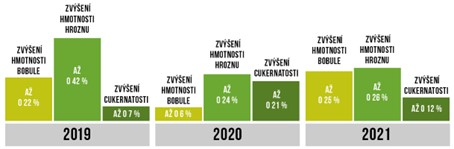
Results of semi-operational trials by Mendel University Brno, carried out at Vinařství Pavlov on the Welschriesling variety in 2019–2021.
The decisive factors, however, are the period in which the product is applied to the plant and the amount of rainfall in a given year. "Probiotics are absolutely ideal for vintages where the grapevine shows stress from drought and high temperatures. Under such conditions they certainly reduce the negative impacts of stress. In vintages with sufficient rainfall and lower temperatures, on the other hand, application during the phase of intensive vine growth proves less suitable," added Professor Pavel Pavloušek. Researchers from Mendel University are now continuing their work and will further investigate the question of when and in what quantities these probiotics should be applied so that the product delivers the best possible results.